Commercial and prohibited speeches are not covered under fundamental rights, the Supreme Court on Monday said as it asked five social media influencers, including India's Got Latent host Samay Raina, to display their unconditional apology in their podcasts or shows for ridiculing persons with disabilities and rare genetic disorders.

'Mr Attorney General, we are seriously concerned about the conduct of the governor. We did not want to say it out loud in court, but he is defying the Supreme Court of India.'

Amidst ongoing tensions with the ruling DMK government, Tamil Nadu Governor R N Ravi has invited Vice President Jagdeep Dhankar to inaugurate a meeting of state university Vice Chancellors in the Nilgiris district, sparking criticism from political parties, particularly the Left, who have urged a boycott. The meeting comes in the wake of the Supreme Court ruling in favor of the Tamil Nadu government regarding the appointment of Vice Chancellors, which has stripped the Governor of his previous authority as Chancellor. The Governor, however, maintains his right to convene the meeting, highlighting the ongoing power struggle between the Governor and the state government. The meeting is scheduled for April 25 and 26.

The Supreme Court on Monday said citizens must know the value of the right of freedom of speech and expression, and exercise self restraint as it mulled guidelines to regulate offensive social media posts.
Trinamool Congress leader and Member of Parliament Mahua Moitra has moved the Supreme Court challenging an order of the Election Commission of India for special intensive revision of electoral rolls in Bihar.
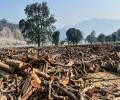
A bench of Justices Abhay S Oka and Ujjal Bhuyan made the observation while rejecting the plea of a man who had chopped down 454 trees in the protected Taj Trapezium Zone.
The West Bengal School Service Commission (WBSSC) on Friday said it would abide by the Supreme Court directive and soon initiate the process of conducting fresh exams for all teaching and non-teaching candidates, who took part in the now-invalidated 2016 job recruitment exercise.
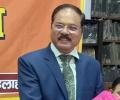
Justice Shekhar Kumar Yadav, an Allahabad High Court judge, is set to appear before the Supreme Court Collegium to explain his controversial statements made at a Vishva Hindu Parishad (VHP) function. The Supreme Court has sought a report from the Allahabad High Court after news reports surfaced regarding Justice Yadav's remarks, which were widely condemned as "hate speech". The judge's statements, made at a VHP event, sparked outrage from various quarters, including opposition leaders and lawyers. The Bar Association of India has also condemned the judge's remarks and called for an apology.
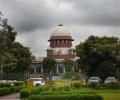
The Supreme Court has raised concerns about discrimination against persons with disabilities in employment, questioning the Centre on the lack of 'upward movement' for meritorious candidates. The court also ordered nationwide monitoring of care institutions for persons with cognitive disabilities.

The Centre has opposed the imposition of fixed timelines on governors and the President for decisions on bills passed by state legislatures, arguing that such constraints were intentionally omitted by the Constitution's framers.

Chandrachud said it should be ensured that courts provide safe and accommodating environment for all members of the society.

On Thursday, MMRDA strongly defended its decision to disqualify L&T from the two infrastructure projects in Mumbai, citing "substantial grounds" for the rejection of its technical bids.

The Ministry of Home Affairs (MHA) has ordered a probe into the September 24 violence in Leh, led by retired Supreme Court judge B S Chauhan, to investigate the circumstances leading to the law and order situation, police action, and the deaths of four people.
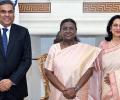
The Supreme Court judges' filings revealed a generally conservative financial ethos, emphasising stability and long-term savings.

Representatives from Ladakh have accepted an invitation from the Ministry of Home Affairs for a meeting in Delhi on October 22 to discuss their demands for statehood and safeguards for the Union Territory.

In a landmark verdict, the Supreme court fixed a timeline for Governor to act on bills passed by the state legislature as it pulled up Tamil Nadu Governor R N Ravi for reserving 10 bills for President's consideration, saying it was against the constitutional provisions.

The Juvenile Justice Board on Tuesday said the 17-year-old boy accused of driving a Porsche car in an inebriated state and mowing down two persons last year in Pune will be tried as a juvenile.
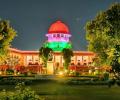
The Supreme Court of India has referred the matter of the Right to Education (RTE) Act's applicability to minority schools to a larger bench for adjudication, expressing concerns about potential misuse and fragmentation of the education system.

The Bombay High Court expressed its dismay over the Maharashtra government's failure to register an FIR against five policemen involved in the custodial death of Akshay Shinde, despite an explicit court order. The court, alleging a deliberate attempt to disregard its directives, threatened contempt proceedings against senior CID officers for non-compliance. The case pertains to Shinde's death while in police custody, accused of sexually assaulting two kindergarten girls in Badlapur. An inquiry report by a magistrate indicted the five policemen, suggesting a possible fake encounter. The court emphasized the importance of following the rule of law and stated that the government's inaction would send a detrimental message to society.

A Supreme Court lawyer has written to the Attorney General seeking consent to initiate contempt proceedings against BJP MP Nishikant Dubey for his "grossly scandalous" remarks against the court. Dubey had criticized the Supreme Court and Chief Justice of India Sanjiv Khanna following the Centre's assurance that it would not implement some of the contentious provisions of the Waqf (Amendment) Act. The BJP has distanced itself from Dubey's comments, calling them his personal views.
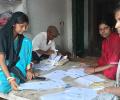
The Election Commission will publish the draft electoral rolls for Bihar assembly polls, triggering a period for claims and objections amid fears of voter exclusion.

The final NRC, a list of Indian citizens residing in Assam, was released in 2019 by excluding 19,06,657 people. However, it has not been notified by the Registrar General of India, leaving the controversial document without any official validity.
BJP-ruled states argued in the Supreme Court that governors and the President have autonomy in assenting to bills passed by state assemblies, asserting that courts cannot mandate assent.

Its August 11 direction, which prohibits the release of stray dogs from dog shelters, shall be kept in abeyance for the time being, the apex court said.
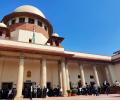
While agreeing to hear his petition on September 27 last year, the top court stayed the proceeding against Murugan that was pending in a special court in Chennai.
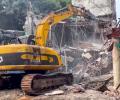
The Supreme Court of India has criticized the Uttar Pradesh government and Prayagraj Development Authority for the demolition of homes in the city, calling the actions "inhuman and illegal." The court ordered the authority to pay Rs 10 lakh compensation each to the homeowners, stating that the demolitions were carried out in a "high-handed" manner without following due legal process. The petitioners, whose homes were demolished, argued that the state government wrongly believed the land belonged to gangster-politician Atiq Ahmed. The Allahabad High Court had previously rejected their plea challenging the demolition.
The Supreme Court of India granted custody of a man suffering from cerebral palsy to his mother, a US national, after determining it was in his best interest due to his inability to make independent decisions. The court overruled a Madras High Court decision, finding the lower court's interaction with the son insufficient to assess his needs. The Supreme Court emphasized the son's limited cognitive capacity and the availability of specialized support in the US, where he had completed most of his schooling.
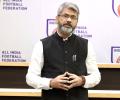
Majority of AIFF EC members to choose between national body posts and state unit office

The Congress party has accused the Modi government of a 'deny, distract, lie, and justify' (DDLJ) policy regarding China, alleging territorial setbacks and misplaced economic priorities.
As per the cause list of October 21 uploaded on the apex court's website, a bench of Justices Surya Kant and Ujjal Bhuyan is slated to hear the matter.
The petitioner's counsel said his client was facing threats of arrest and torture in his country as he was a former Liberation Tigers of Tamil Eelam member, and that his wife and children had settled in India.

Malik, who is in jail following his conviction and life sentence in a terror funding case, was brought to the high-security apex court premises in a prison van escorted by armed security personnel without the court's permission.

The man accused of attacking Delhi Chief Minister Rekha Gupta told investigators he planned a protest against the Supreme Court's order on relocating stray dogs, similar to Anna Hazare's anti-corruption protests.
The report, according to the sources, states that the HC did not get the note of the Supreme Court collegium on the issue even after six months.

A bench of Justices BV Nagarathna and Ujjal Bhuyan also rejected the application for listing review petition in open court.
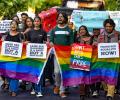
A five-judge bench of the Supreme Court will consider review pleas challenging the October 2023 verdict that declined legal sanction to same-sex marriage. The review pleas will be heard in chambers on January 9, with Justice P S Narasimha being the only member of the original bench that delivered the verdict.
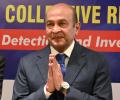
The Union government is considering an impeachment motion against Allahabad High Court judge Yashwant Varma, who was indicted by a Supreme Court-appointed probe panel after burnt cash was found at his residence. The government is likely to consult with opposition parties before moving forward with the motion, which would require a two-thirds majority vote in Parliament.
The Supreme Court of India has formed a National Task Force (NTF) to address the growing concern of student suicides in higher educational institutions. The court took note of the recurring cases and directed Delhi Police to register FIRs on the complaints of families of two students who died by suicide at IIT Delhi in 2023. The NTF, chaired by former apex court judge Justice S Ravindra Bhat, will prepare a comprehensive report, including the identification of causes leading to suicides, analysis of existing regulations, and recommendations for strengthening protections. The NTF will also have the authority to conduct surprise inspections of higher educational institutions and make further recommendations to ensure a holistic approach to addressing mental health concerns and eliminating suicides.
Four days after the top court cleared 10 bills, which were stalled and reserved by Tamil Nadu Governor R N Ravi for the president's consideration, and set a timeline for all governors to act on the bills passed by the state assemblies, the judgement running into 415 pages was uploaded on the apex court's website at 10.54 pm on Friday.

The Supreme Court of India has ordered a progressive reduction in the deputation of Indian Police Service (IPS) officers to Central Armed Police Forces (CAPFs) over the next two years, citing concerns over the delayed promotions of cadre officers. The court's decision aims to address the long-standing grievances of CAPF officers who feel their promotional prospects are hampered by the presence of IPS officers in higher ranks. The ruling also mandates a cadre review of the CAPFs to be completed within six months, addressing the issue of stagnation in the service hierarchy. The court's decision acknowledges the valuable contributions of CAPF officers while also recognizing the need to balance their promotional prospects with the operational requirements of the forces.
